
All resources

Review by exception: designing it into the MES

Your reviewers read the whole batch record, even when everything has passed. Review by exception changes that. The MES flags what deserves analysis, and the reviewer focuses on it. But this has to be prepared before production. Here is how, followed by an example based on a washing operation.

What is review by exception?

It is a way of reviewing the batch record. Everything stays recorded in the record, passed results and deviations alike. But the reviewer no longer reads every line. The MES presents only the items to examine: an out-of-limit value, a failed visual inspection, a data correction, an intervention requiring justification.

What does it change for your reviewers?

They spend less time on records with no issues and more time on the real ones. On one of our projects, review of media preparation records went from three weeks to half a day.

How do you decide what the MES flags?

Through a risk assessment, element by element. For each piece of data in the record, you ask two questions. Where does it come from: manual entry, automatic calculation, a qualified interface? And what happens if it is wrong, for the process and for the patient? Elements at risk stay under review. The others leave systematic review.

Quality assurance approves this assessment. Without its agreement, nothing changes in how records are reviewed. On our project, the assessment covered more than ten thousand MES elements.

What about audit trails?

They matter mostly for what happens outside the batch record. For example, an operator manually changes the cleaning status of a piece of equipment. This action appears in no record, but it may affect the batch. The review strategy must state which actions of this kind are flagged for review, with their author and time.

Who checks what?

Three actors can check a piece of data. The equipment or SCADA, which evaluates its own cycle. The operator, who observes and records a result. The MES, which checks a value or a rule at the relevant step. For each check, you decide which of the three is responsible. Then you configure the master batch record (MBR) with that data, those rules and access to evidence.

Next you organise the review workflow: who assesses, who justifies, who signs, on the production side and on the quality side. And you specify what blocks production immediately, and what can wait for the review.

Finally you test the full path with users, from the equipment result to the reviewer’s decision. And you update the rules whenever the process or the interfaces change.
The principle and its implementation in the MES

Illustrative example · a washing operation

The cycle passed. What about the load?

The washer evaluates its cycle. The operator inspects the washed items. The MES combines both results to establish acceptance of the washing operation and highlight exceptions.

Explore the inspection steps
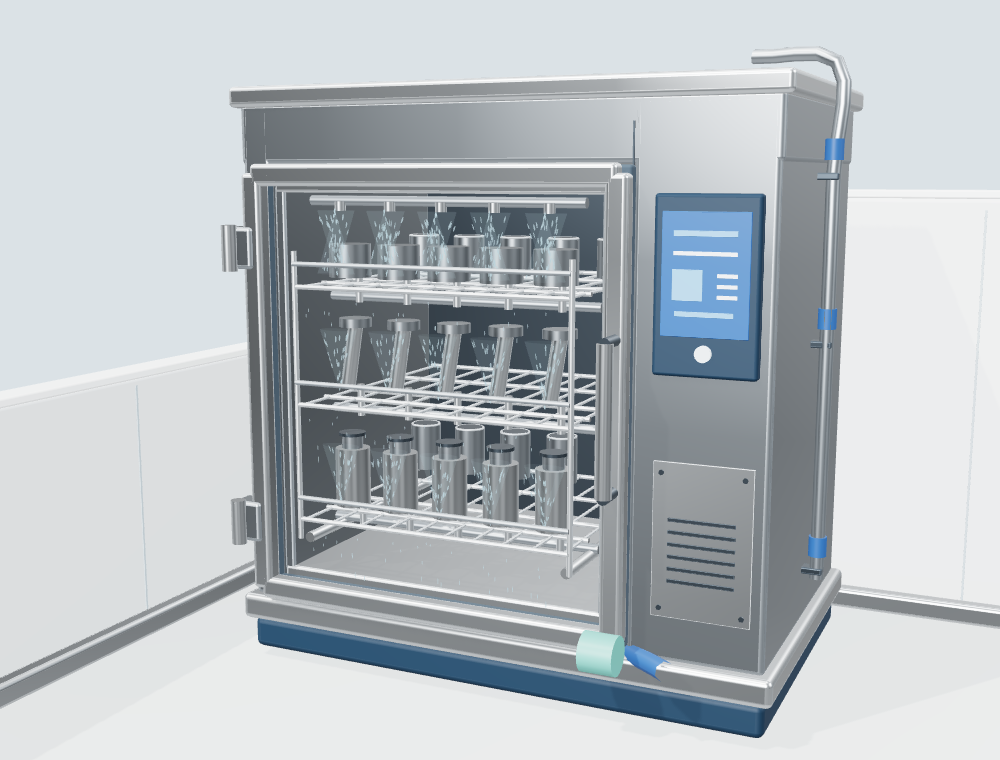
Cutaway washer view: racks of parts, spray nozzles and fluid circulation.Illustrative cutaway view
The cutaway locates the parts and washing circuits. Choose a phase to understand its checks. The real machine stays closed during operation.

What the washer checks

Observe a phase

Spray nozzles and injectors distribute cleaning solution over the parts and inside components connected to the rack.

The equipment monitors recipe parameters: time, temperature, circulation and dosing, according to the chosen design.

Try a result sent to the MES

The cycle checks pass. The equipment sends a passed verdict linked to the cycle and load.

Cycle acceptanceCycle passed
Visual acceptanceNot yet performed
Overall result in the MESAcceptance not established

Illustrative example: criteria, evidence and rules must be defined and qualified for each site. The result concerns the washing operation, not batch release.

Why a passed cycle is not enough

Take a washer. It runs its recipe, monitors time, temperature, circulation and dosing, then gives a verdict: cycle passed or not. The MES receives this verdict, with the cycle and load references and a link to the report. It recalculates nothing.

But the machine’s verdict does not say whether the parts are clean. After the cycle, the operator inspects the equipment and looks for residue or marks. They record the result in the MES, with their name and the time.

The rule is simple: both are needed. A passed cycle with visible residue is still a failure. A satisfactory visual inspection does not rescue a failed cycle. Until the operator has recorded the result, the operation has not passed.

Vendor source: Getinge · cGMP washing and final-rinse monitoring

What does the reviewer see in the list?

Three possible situations.

  • Both checks are good. The MES keeps the verdict and the visual inspection in the record. Nothing appears in the review list.
  • One of the two is bad. The MES raises an exception, with its source (the machine or the operator) and the information needed to analyse it.
  • The visual inspection was not done. The MES shows that the inspection must be completed. The passed cycle is not enough.

Example: the cycle passed, but the operator sees residue when unloading. They record a failed visual inspection. The record keeps both results as they are, without rewriting the machine’s. An exception goes to the reviewer.

What does the reviewer need to decide?

From the list, they must find in one click the rule that triggered the exception, the result received, its context and the evidence. They assess the impact, write their conclusion and record their decision or request an action. The history keeps who handled the item, when, and on what basis.

When should all this be designed?

From the scoping of the MES project, not after go‑live. Take a concrete situation, like this washing operation, and follow it from the equipment to the reviewer’s decision. This thread serves everything: design, configuration, testing and user training.

Tests must cover at least five cases: both checks good, a cycle deviation, a visual defect, a forgotten visual inspection, and a result linked to the wrong cycle. After go‑live, any change to a recipe, an interface or a check requires an impact assessment.

Sources

Siemens · Batch record design, execution and review

A topic to address on your project?

Let’s talk it through with Mathias Louis, Maelo’s founder.

Contact Mathias

An assignment on this topicDefining and implementing review by exception in an existing MES